
Clare Rood/Mary Dodge descendants and ancestors
A Boy on the Farm 1898-1912
(birth) 13 Feb 1898 Covert, Van Buren Co., MI - Clare Alfred Rood was born on his parent’s farm, one mile north of Covert Village, MI. He was the 4th child of Frank E Rood (age 33) and his wife Anna E. Atkinson (39). He joined brothers Edward (7) and Paul (5) and sister Edith (2). Two younger sisters followed- Josephine (2 years later) and Genevieve (8 years later). Clare never knew his Grampa Rood- Edward Ariel Rood died 9 Feb 1897, a year before Clare’s birth. He did know his three other grandparents well- Grandma Josephine (Fish) Atkinson died 26 Aug 1906 when Clare was 8, Grampa Joseph Atkinson died 25 Nov 1909 when Clare was 11 and Grandma Flora (Warner) Rood died 25 Sep 1918 when Clare was 20. All three died in South Haven.


(age 12) 1 May 1910 Covert Twp. –While his older brothers had gone to high school in South Haven (renting a room on the corner of Broadway and Erie), Clare attended elementary school 1 ½ miles away in Covert Village. He recalled riding a pony named Belle with his sister Edith to and from school. During the school day, they would put the pony in a horse stall (owned by the family) at the Congregational Church across from the school and Clare would feed it during his own lunch time. His younger sister Genevieve wrote her “Memories of an Old Lady in a Hurry” in 1991 at age 84. Some excerpts as they apply to living on the farm:
I remember when the bathroom was installed... and the first roll of toilet paper I ever saw. Sears Roebuck catalogue had been in the outhouse with 3 adult holes and a small, lower one. Mother Anna and Aunt Clara were active in the Women’s Christian Temperance Movement. [There was large stone near the outside kitchen door where] my father stood me the night I saw Halley’s comet in 1910. On the west boundary of the farm there was a hickory tree where we used to gather nuts for making the favorite birthday cake, a white layer cake with sour cream nut frosting and filling. A favorite pastime was boiling maple syrup tapped from the trees on the north border along the road. This was Clare’s special job. After boiling the syrup to the soft ball stage, it was stirred until creamy, then poured, quickly before it hardened, into the special metal heart-shaped molds.
I used to love going out to the barn to see the horses. [They had] Rhyrus and Colonel, two big Clydesdale work horses [mares, very gentle], Old Jim and Old Heck, two ‘driving’ horses and Gypsy, Snip and Topsey, young colts trained as riding horses. In winter we had bob-sled rides complete with buffalo robes and soap stones to keep our feet warm. The horses who pulled the big sled wore bells that jingled in the frosty night. Afterwards we would have popcorn back in the big kitchen or maybe oyster soup or a taffy pull.
Adjacent to our farm house was the granary where oats, wheat and shelled corn were stored in open bins. Underneath this building was the cold cellar where winter vegetables were stored, also milk and cream in crocks covered with plates. The shop was a fascinating place too with it’s big anvil and all the tools necessary for repairs on the farm.
On Sunday afternoons we often made fudge or played Flinch. Regular card playing and dancing were considered sinful. Edith had learned to play the piano so she would play and the family sang hymns in harmony. A favorite snack was popcorn in milk skimmed off before it had time to get soggy. My Quaker and Puritan ancestors had a great influence on our family life. Social life was very simple. Sunday nights [the family children] always went to the church youth group called Christian Endeavor where we were expected to take turns leading the meetings.
Clare is listed in the 1910 U.S. Census (age 12) as both a ‘student’ and a ‘farm laborer’. Clare recorded his memories from his youth on the farm in a video tape, recorded by his grandson Allan Rood in August 1984, the day before he collapsed, dying a few days later. <Click here for a link to the video on YouTube> One of the things he mentioned in that recording was that he considered himself a man when he could do a man’s work on the farm. The example he cited was lifting a haycock onto the wagon with a pitchfork. It was a two-man job and the lift had to be coordinated and equal. He guessed he was 13 or 14 when he could hold his own on his half of the lift with a hired hand on the other side. He also mentioned that the family had a windmill on the farm. It pumped water to an elevated supply tank, so they had running water in the house. The windmill also pumped water to a tank in the barnyard for the stock to drink.

The School Years 1912-24
(age 14) 1912 South Haven, MI – Clare moved with the family from the farm about 7 miles north to a three-bedroom house at 844 Phoenix St., allowing the children to be closer to their school. According to Genevieve’s journal, the rent was $10 per month and “there was a toilet in a small closet just off the kitchen on the upper level of the woodshed. A big galvanized washtub was brought in before the kitchen range and used as a bathtub. The lights were kerosene lamps until years later when gas mantles were installed. Chamber pots were under the beds and it was the duty of the girls to empty and rinse these every day. At least once a week the lamp chimneys had to be washed and the wicks trimmed. Mother did all the laundry by hand in the west end of the kitchen, bringing in bench, tubs and wringer as well as the washboard.” Genevieve described one way to visit the cousins and uncles on the family farm, eight miles away from South Haven to Covert: “… I was allowed to walk to the [Kalamazoo, Lake Shore and Chicago] station downtown, give Mr. Bell the conductor a dime for my fare to Covert. Getting off at the depot there, I could walk “crosslots” to the farm [about 1.5 miles] to visit.” Clare had a bicycle that the kids used to get around town. “Clare had the wood to chop for the kitchen stove and the garden to tend. We had vegetables in the back yard and mother grew zinnias and cosmos there too. In the spring, 2 or 3 days were devoted to housecleaning. Our rugs were ‘Olson’s’. Old clothing was sent to the Olson Rug Co. in Chicago where it was processed and made into rugs. These were taken out and put over the wire clotheslines where we children beat them with heavy wire rug beaters. The wallpaper was cleaned with a pink putty like substance, curtains were wash and rehung, windows washed and feather beds aired.”
(age 18) 9 Jun 1916 South Haven, MI – Clare graduated from South Haven High School. He was elected as Class President his freshman and junior years and was involved in a large number of activities during these four years. It is during this time that we first see evidence of his love of singing. He was in the high school choral for two years and during this time the South Haven newspapers reported his singing in several duets and quartets, often joining his sisters Edith and Josephine. His nickname was “Chum” to both friends and family. Commencement exercises were held Friday evening at the Congregational Church. The class roster included 66 students their freshman year and 44 at graduation, including his sweetheart and future wife Mary Dodge. The quotes the two of them selected to accompany their pictures in their senior yearbook were: Mary “I’m happy because I am living and because he is here” and Clare “So deep in love am I”.


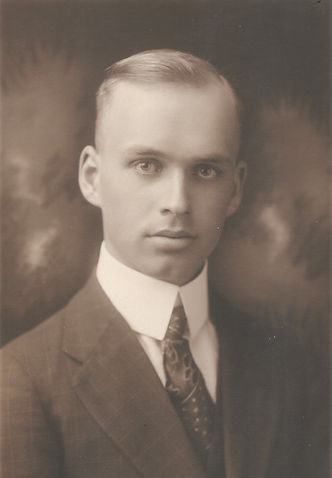
(age 18-22) Sep 1916 – Jun 1920 Michigan Agricultural College, East Lansing, MI, college student – Clare left South Haven on 26 Sep 1916 with high school buddy and class valedictorian Lloyd Spencer to enroll at M.A.C. In addition to his studies, Clare continued his extracurricular activities. He and Lloyd were in the Fruit Belt Club (21 members, Lloyd was President), they both were in the social fraternity “Hermina” (40 members) and both were inducted into the honorary botanical society “Seminarius Botanicus (16 grad student members and 20 undergrads). Clare was on the board of his Junior yearbook and on the “J-Hop” committee, “the biggest social event of the college year” put on annually by the Junior Class. He also found an outlet for his love of singing as a member of the Glee Club his Junior and Senior years- he was one of six “second basses”. There were costs associated with these activities, which he discussed in a Feb 1919 letter to his father, whom it interestingly addressed as “Dear Daddy”:

Tho’t I’d write and ask you about my financial problems. Here is a crude & incomplete budget of expenses I’ve got to meet. The greater share of it probably within the next two weeks, at least half.
Dues for Junior Hop 7.50
“ “ Society party 3.00 These I know will come
Regular Society dues for the term 5.00 before the end of the month
Insurance 6.50 laundry is each month
Laundry next term 3.75
25.75
Probably you will think I’m spending some money foolishly, but I’ve got to keep up in my Society & I think the Junior Hop will be worth the price anyway. I just tho’t you’d understand better if I gave you some figures. Now what I want you to do is to see if you can borrow about $25 for me & give a Liberty Bond as security. I don’t want to loose that Bond for I’ve found I’ll keep it but I don’t know as I could do much else just now. I don’t want to ask you to send so much because I know you have so much & I’m wondering how the Roods covered the expense of Paul’s operation. I don’t think you should borrow money to send me when I’ve some sort of security. If that will work maybe you could see to it. I’m writing because our Society Party is Feb 28 & I must have my dues in before then & also my insurance must go in.
Goodnight Daddy
Your kid
Clare
Clare also worked while attending college. His WWI draft registration listed his occupation as “Assistant to State Inspector of Orchards”. On 4 Oct 1918, the start of his Junior year of college, Clare enlisted in the M.A.C. Student Army Training Corps, a new branch of military service. Enlistees were given college schooling, military drill and the uniform and pay of privates. Clare was among 75 students “displaying aptitude for leadership” and was selected to attend the officer’s training camp at Camp McArthur, Waco, Texas. In a stroke of good fortune, the Armistice between the Allies and Germany, their last remaining opponent, was signed 38 days later, on 11 Nov 1918. Clare was honorably discharged from military service 18 days later on 29 Nov 1918 having served a total of 56 days. The Germans must have heard he was coming and decided to call it quits. In spite of this brief service, Clare was apparently able to keep (or purchase) the rifle he was issued during his training. It was an 1873 model Springfield 45-70 trapdoor. The gun was passed on to Clare's son Dave, and after Dave's passing to Dave, Jr. and Kathy. In August 2024, the rifle was passed on to Bob's son Dan Rood, who now holds possession, following a nifty shooting exhibition at a rifle range.


Clare returned to campus and received a Bachelor of Science in Agriculture (Horticulture Department) from Michigan Agricultural College (current Michigan State University) on 16 Jun 1920. He was one of 214 listed on the commencement program as receiving Bachelor degrees- 96 in agriculture, 62 in home economics, 48 in engineering and 8 in forestry. Eight Masters degrees and eight Doctor of Veterinary Medicine degrees were also granted. Clare’s parents and sister Genevieve attended.


(age 22-24) Sep 1920 – Jun 1922 (possibly 1923) Tapiola, Houghton Co., MI, instructor – Clare’s first job after college was as principal and instructor at the Otter Lake Agricultural School, a K-12 school located about 15 miles south of Houghton in the Upper Peninsula. To get there from South Haven, he had to drive around the south end of Lake Michigan, through Chicago, through the length of Wisconsin and into the U.P., a total of over 650 miles, about the same distance as driving from South Haven to Philadelphia, PA. The school was founded by and later (1922) named for John H. Doelle, then superintendent of the consolidated Houghton and Portage Lake public schools, later Commissioner of Agriculture for the State of Michigan. In 1913, a road was built from Houghton to Tapiola, a tiny, predominantly Finnish farming community, and the school was built, the first consolidated rural agricultural school in Michigan. Teaching focused on a “practical” rather than academic education.


Nonnie described the school building as “like any of the other ten million modern school buildings in any city, fully equipped, and accommodating about two hundred children”. Like other predominantly Finnish communities, the area included several Lutheran churches and a co-operative store in Tapiola. While researching online this part of Clare’s life I stumbled on the following interesting post on another family story:
Jeremiah [Peterson] died suddenly of a heart attack in November of 1920, leaving Ida with five of the eight children to care for alone. It was necessary for the widow to seek welfare aid since now there was no wage earner, and the small farm, now only 40 acres, provided only part of the family's needs for survival. After much investigation by the welfare authorities, aid was at first refused because the report was that the house she and her children lived in was too clean and that her children were clean and well clothed. The principal of the Doelle school at the time knew the plight of the family and spoke up in their behalf at the welfare office, explaining that just because the mother and children were not slovenly and lazy was no reason to believe they needed no financial assistance. After this intercession by Mr. Clare A. Rood, the principal, Ida Peterson received fifteen dollars a month. It is difficult to believe but, with this money she was able to buy shoes, yard goods, and staples which could not be grown on the farm.

The original school burned in 1929 and was rebuilt in 1930 with a brick building, still standing today but abandoned for years.
Wedding and honeymoon 1921
20 Aug 1921 South Haven, MI, marriage – Following his first year in Tapiola, Clare (age 23) and his high school sweetheart, Mary Dodge (age 24), married at the home of her parents. Standing with Clare as best man was his high school and college buddy Lloyd Spencer. Two years later, on 31 Dec 1923, Clare returned the favor and stood for Lloyd during his marriage to Corlan Gladys Lyman in Casco Township, Allegan County. The South Haven Daily Tribune gave a very nice report on Clare and Mary’s ceremony and reception, including their rather novel escape from the hijinks planned by their friends. Honeymoon- Their honeymoon (described by Nonnie as “a most perfect week”) was spent at Palisades Park, a summer resort on the sand dunes of Lake Michigan, about 7 miles south of South Haven. They spent a relaxing week. Nonnie wrote “First every morning, as soon as we were up, we would rush down for an early morning dip… We also played tennis, took long hikes and auto rides and then we would spend the afternoon at the beach in bathing. The several families came out to visit us at different times (To keep us from getting lonesome- eh).” Following their honeymoon, they traveled in Clare’s new car to their home, arriving September 5th at Tapiola, where they both would be teaching the following year. They may, in fact, have taught another year- third year for Clare and second year for Nonnie. I can’t find a record to indicate what else they may have done between Sep 1922 (end of Clare’s second year) and May 1923 (Clare’s start with the Extension service below).


Brief interim jobs 1923-24
(age 25) May 1923 – Aug 1923 Chassell, MI – Clare’s first connection with the M.A.C. Extension service was for four months, serving as the Boys and Girls Club (current 4-H) leader for Houghton County. His salary as a County Club agent was set at $2,700; $50 per year was paid from Federal “Lever” funds, the balance paid by the county. On 30 Aug 1923, the South Haven Daily Tribune reported that “Edward Rood and son Alton, and Paul Rood recently drove their trucks to Tapiola, Mich., where they will assist their brother Clare in moving to Hesperia, Mich.” I am indicating that during this time they lived in Chassell instead of Tapiola because Clare told the M.A.C. alumni newsletter that he “has moved from Chassell to Hesperia, Michigan.” Chassell and Tapiola are about a dozen miles apart.
(age 25-26) Sep 1923 – Apr 1924 Hesperia, MI, superintendent – Clare is Superintendent of schools for one year. Hesperia is in central western part of the lower peninsula, about 95 miles north of South Haven. The picture at right is taken from the first page of the1924 Hesperia High School yearbook. The dedication reads: "To Professor C.A. Rood Superintendent of the Hesperia Public school, to whose earnest efforts, we feel the success of our Senior Class of 1924 is largely due, we affectionately dedicate this volume." I have no other information on this job.

Extension Service 1924-42
Clare held a variety of positions with the Boys and Girls Clubs (current 4-H), that were part of the Extension Service of Michigan Agricultural College (current MSU). The Extension Service was a cooperative enterprise between the United States Department of Agriculture and land grant colleges. It was organized and conducted under the terms of the Federal Smith-Lever Act of 1914. The Act provided that “Cooperative agricultural extension shall consist of the giving of instruction and practical demonstrations in agriculture and home economics… through field demonstrations, publications and otherwise.” The extension program for farm boys and girls between the ages of 10 and 20 was carried on through the 4-H clubs.
(age 26-30) 16 Apr 1924 – 9 May 1928 Saginaw, MI – Clare was appointed County Club Agent (4-H) for Saginaw County by the State Board of Agriculture, effective 16 Apr 1924. His starting salary was set “at $2,000 per annum, $600 from Federal Smith-Lever funds.” Nonnie must have stayed with family in South Haven during the end of her pregnancy as that is where their oldest child, Robert Clare Rood, was born three months later, on 20 Jul 1924 (Clare was 26 and Nonnie was 27). Less than a year later, Clare’s father, Frank Edward Rood, age 60, died on 3 Feb 1925 of pernicious anemia (Clare was 26). It was while they were still in Saginaw that their second son David Alfred Rood was born on 20 Feb 1926 (Clare and Nonnie were both 28 and son Bob was 18 months old). It appears they lived in a small house at 1000 N. Mason Street (no longer standing) for all four years.
(age 30-44) 10 May 1928 – 31 May 1942 Marquette, MI – note that these dates mirror the Great Depression, generally defined as starting with the Black Friday stock market crash in Oct 1929 and ending when the government began heavy military spending in 1940. Unemployment peaked in 1933 at around 25%.
Following the resignation of M.L. Wright, Clare was appointed Assistant State Club leader for the Upper Peninsula, effective 10 May 1928. His salary was set at $3,300 per year, a substantial increase over his County Club Agent salary in Saginaw. A few year later this was raised to $3,400, but due to over-all budget cuts connected to the Depression, was reduced to $3,000 for 1932-33. This salary remained little changed during the remainder of his tenure, ending at $3,100 for the 1941-42 year. This new job appears to have resulted in a substantially higher work load. Newspapers from the time regularly reported his frequent visits to the local clubs- west to Ironwood and Bessemer (150 miles); east to Munising (42 miles), Newberry (100 miles) and Sault Ste. Marie (165 miles); north to Houghton (100 miles) and home base of Marquette and south to Manistique (165 miles), Escanaba (70 miles) and Menominee (120 miles). This obviously resulted in a lot of time on the road. Add to that the Upper Peninsula winter weather and the road conditions and snow removal during that time. During these depression years, membership in 4-H was large. In 1928, Delta County (Escanaba) alone had 20 clubs and there are 15 counties in the U.P.- every small, rural village had a club, and Clare visited every single one at some point.
Some of his many duties included: visit clubs to observe progress, give addresses at club meetings, annual club inspection visits, hand out awards at achievement exercises and banquets, serve as judge at local fairs, county fairs and the Upper Peninsula State Fair, take award winners to the State Fair in Detroit, attend Extension conferences in the U.P., East Lansing and other places including Washington, D.C. at least once. Camp Shaw was the U.P. 4-H summer camp and was located in Chatham, 30 miles east of Marquette. Although Camp Shaw had a dedicated superintendent, Clare would have visited often. He would visit all individual clubs twice per year to discuss the various phases of that season’s work- winter clubs and summer clubs. At the end of each season, he would return to judge the work. Some visits may have been day trips, but many, due to distances and time of event (evening), may have involved an over-night stay. In December 1928, seven months after starting in Marquette, Clare took a group of 18 boys and girls by train from Marquette, through Escanaba to Chicago for about a week. While there, they attended the International Livestock Exposition and the national Boys’ and Girls’ Club Congress. The group consisted of a boy and a girl from each of 9 counties; some were prize winners at the U.P. or State Fairs while others were selected by their clubs for outstanding work during the year. This appears to have been an annual event.
One family story from this time period was shared by Clare’s grandson Allan Rood:
Dad [Bob Rood] remarked once that Grampa Clare was a very honest man. One time they went fishing and had not caught anything all day. As it was getting dark, he finally caught one fish and threw it into the bucket and they went home. When he got into the bright kitchen light to clean the fish, he discovered that it was a different type than he assumed, one that was undersize. He was supposed to throw it back. Dad said "He was so upset, I thought he was going to try and give it mouth to mouth to resuscitate it and drive back to the fishing hole". He was too upset to eat it.
Clare’s duties revolved around the boys in the clubs. On most of his trips he was accompanied by a woman who held responsibilities for the girls in the club. For the first couple years, there was a number of different women, sometimes referred to as his assistant, other times as a home demonstration agent. Effective 1 Feb 1936, Miss Marcella Meyer (age 30) was hired to replace Miss Olga Bird, who had held the position for just over five years and was being promoted to the headquarters in East Lansing. Both Olga and Marcella had the title of Assistant State Club leader, the same title as Clare, indicating they were not his assistants, but rather an equal, holding the same responsibilities for the girls in the clubs as Clare did for the boys. However, they did not receive equal pay. As was typical for the times, the starting salary for Marcella, a woman and single, was set at $2,200 per year, 25% less than Clare. At the 1941-42 fiscal year, Marcella was making $2,500 per year. Marcella was born and raised in northern Indiana, received a Bachelor of Science Degree in home economics in 1927 from Western State Normal School in Kalamazoo, MI (current Western Michigan University) and had been in charge of the home economics department at the Petoskey, MI high school for the preceding nine years.
Family Events During this Period 1924-42
(age 31) 23 Jan 1930 South Haven, MI – Clare’s mother Anna (Atkinson) Rood died in South Haven at age 71 of a coronary embolism.
(age 34) 29 Jun 1932 Marquette, MI – Clare and Mary’s daughter Mary JoAnne Rood is born.
(age 35) date? 1933 Chicago, IL – the National Committee on Boys and Girls Club Work commissioned Clare to write the words and music to the song A Song of the Open Country. (click here for copies of the sheet music) Singing was a big part of 4-H meetings at this time and the song was included in the song books of state clubs. A quick internet check found it in Montana, Connecticut, West Virginia and Missouri. A 1941 circular by the Missouri Extension Service provided the ‘backstories’ for several songs in their song book. For this song they wrote:
Mr. Rood who enjoys music and singing was returning to his home from a Michigan 4-H Camp when he found himself humming a certain tune over and over. At home, his wife wrote down the notes of this melody which became the Song of the Open Country. Later he worked on the words for several months, and when he presented them to a group of his co-workers the song seemed especially worth while. The piano accompaniment was written by Arthur Farwell, an instructor in music. This song is easily sung because of its good rhythm and the words are an excellent expression of our 4-H ideals.
Clare also wrote the words and music to the 4-H Greeting Song in 1936, but I have not been able to find a copy of that song. Grandson Jim Rood related the following anecdote: "One day during the war [Clare's son Bob] heard a fellow soldier whistling and singing one of Clare’s 4H tunes. The first time a rock star hears their song on the radio is a moment they treasure (and for those around them). I know [Bob] treasured this moment as well."
between May and Nov 1933 Chicago, IL – Aunt Mary Jo confirmed that Clare took the family to the 1933 Chicago World’s Fair, known as "A Century of Progress International Exposition". I have a cast iron toy Greyhound bus that my father got at the fair. Would it be too much of a stretch to link the trip to the publication of A Song of the Open Country? Both events happened in 1933 and both the fair and the club headquarters were in Chicago. Sometimes it’s fun to speculate. The fair was quite an event- here is a link to an extensive description on Wikipedia. Several years ago I purchased a number of items related to the Fair from various auctions on eBay. My wife Tina had them put into a shadow box with the toy bus to make an attractive display that hangs on the wall behind my chair.


Where did they live in Marquette? During these 14 years in Marquette, the family moved fairly often. They first lived in half of a duplex at 609 Pine Street, which the 1930 census says they rented for $35 per month. The other half of the duplex was rented for $40 by Frank Hansen, the state veterinarian, who had two sons almost identical in age to Bob and Dave. The 1935 City Directory lists them at 322 W. Magnetic Street (a small, two-story house one block from the hospital and near the college; rent not shown). The 1937 City Directory lists the family at 358 E. Hewitt, another duplex about a block from where they had previously lived on Pine Street. Their final home was just around the corner from their former Magnetic Street home and was located at 1115 N. 4th Street. The 1940 census indicates they rented this home for $40 per month. The picture at right is Feb 1938 on Hewitt Street. It is of Nonnie, the car they took to Mexico and California and a typical Marquette winter.

(age 38-39) Leave of absence Jan – Jun 1937- At the 23 Nov 1936 meeting of the State Board of Agriculture, it was approved “that Mr. C.A. Rood, Assistant State Club Leader, be granted leave of absence with full pay for health during the period January 1st to June 30, 1937.” The stress of the job had gotten too much and time off was the cure. During his absence, his duties were covered by several men out of the East Lansing headquarters. Clare took the family on a Trip of a Lifetime- They left South Haven on 11 Jan 1937 and completed their 11,000 mile car and camper trip by returning to South Haven on 15 Jun 1937. For a complete recap of this incredible journey, including the diaries of sons Bob and David, pictures, narratives and more <click here>. At the end of that page is a link to return to this spot in Clare's story. Apparently Clare was refreshed enough to restart his job in Marquette on July 1st.


(age 44) 1 Jun 1942 – 15 Nov 1942 Petoskey, MI – the minutes of the 16 Apr 1942 meeting of the State Board of Agriculture reported the “Transfer of C.A. Rood from his position as Assistant State Club Leader for the Upper Peninsula to the position of District Club Agent for Charlevoix, Antrim, Emmet and Cheboygan Counties at no change in salary, effective June 1, 1942. This transfer is necessitated because of illness in Mr. Rood’s family which requires his being home more frequently.” This was the northern tip of the lower peninsula, and Clare chose to settle the family in Petoskey. I have not determined which, if any, family member had health issues. That may have been a polite cover for the real story. As his son Bob later phrased it: “My father worked for the 4-H club… and they didn’t like the way he behaved toward a fellow employee.” This solution of separation did not last for very long. A few months later, the minutes of the 17 Sep 1942 meeting of the Board of Agriculture reported the “Resignation of Clare A. Rood as District Club Agent at Petoskey, effective November 15, 1942. Mr. Rood is seeking an extension position in another state.” The minutes of the 23 Oct 1942 meeting of the Board reported the “Resignation of Marcella Meyer as Assistant State Club Leader for the Upper Peninsula, effective November 15, 1942”, the same effective date as Clare. The 2 Dec 1942 Ironwood Times reported that Marcella “… has resigned to accept a position as a nutritionist for a national restaurant chain.” Son Bob later wrote of their time in Petoskey: “I didn’t know it at the time, but my parents were in the middle of a divorce, hence the reason for our moving… [Clare and Marcella] travelled a lot together, she would instruct the girls in the finer arts of homemaker and my father would instruct the boys in the art of farming. My father decided he would like to spend all his time with her. My mother tried her best to keep the family as normal as possible, but my father decided to leave and so the family was broken.”
Separation and Divorce 1942-44
Clare and Nonnie separated in late 1942. Nonnie filed her divorce petition on 6 Nov 1943 in St. Joseph County where she was then teaching. Their marriage was dissolved effective 12 May 1944 with a decree of divorce from the circuit court. Clare was 46, Nonnie 47, son Bob was 19 and had enlisted in the Army a year earlier, son Dave was 18 and just enlisted a month earlier while daughter Mary Jo was 11. At this time, the law required that one partner be at-fault in order for the couple to pursue the termination of their marriage and a reason needed to be stated. In the divorce record, Nonnie states the cause as “extreme and repeated cruelty”. This loaded phrase was one of several popular with attorneys of the day and did not necessarily mean physical cruelty. Obviously, Nonnie was granted custody of Mary Jo, but Clare was given “the right to visit said child at all reasonable times.” He was ordered to pay alimony for the support and maintenance of Mary Jo in the amount of $10 per week until her 17th birthday. He was also ordered to pay a one-time property settlement to Nonnie in the amount of $1,151.80, which he had fully paid by the date of the decree.
It is difficult for me to judge Clare in this matter- I only knew him years later as an elderly, loving grandfather. There are always two sides to every story. There is no doubt that he left Nonnie, as a middle-aged, single mother, in a very difficult situation and she was rightfully very bitter. It took my father Dave many years to reconcile with his father, but they eventually became very close. As executor of Clare’s estate, my father came across some letters Clare had saved, indicating he valued them. They were from John Marvin, St. Joseph County Clerk, through whom Clare would have made his child support payments. They were dated June 1949, just before Mary Jo was turning 17 and the payments were scheduled to end. Clare inquired if his payments were current and apparently indicated that he intended to continue making payments beyond the stipulated ending date. Mr. Marvin responded:
I wish to thank you for your letter of June 10th, and the birth certificate which you furnished. I will proceed to furnish the figures on your account. However, it will take a few days.
I am indeed pleased with your attitude in this matter and your desire to be of assistance to this young daughter. She is a very fine young girl and will need much of your help as you are most certainly acquainted with the high cost of living these days. Your idea to pay her direct is very good and I am sure that she will appreciate the kindness and fore-thought of her father. I want you to know that your account is one of the best handled in the records of this Office. It is true that all parties suffer when a divorce is granted but I most certainly believe that you have done everything that a man can do to keep your obligation morally and legally. Please excuse me for giving my personal comment but I feel that you have done exceedingly well and will continue to do what is right by your daughter.
Mr. Marvin followed up that letter with another a week later where he provided a copy of the file and a statement of Clare’s account, which indicated he was overpaid by $20. He then repeated some of the compliments from his previous letter and ended it with: “I first opened the doors of this Office January 1st, 1933 as County Clerk and during that time to the present I have never had an account of this nature handled with more consideration on the part of the payor.”
The Ft. Wayne Years 1943(?)-84
I have not been able to find much in the way of information as to when Clare and Marcella moved to Indiana or what work they were able to find following their November 1942 resignations from the Michigan Extension Service.
On 18 Sep 1944, four months after his divorce from Nonnie was final, Clare (age 46) married Marcella Mary Meyer (age 39) in Marion County, Indiana. Marcella was born 29 Mar 1905 in Noble County, Indiana, the fourth of five daughters of Louis and Cora May (Moorhouse) Meyer. She graduated from Kendallville High School in 1923 and Western State Normal School in Kalamazoo, MI (current Western Michigan University) in 1927. She taught home economics at Petoskey, MI high school for nine years and was with the Extension Service in Marquette for six years. The 1944 City Directory for South Bend has Marcella employed as a teacher at St. Mary’s College and residing at 1010 E. Indiana St. This was her first marriage. At some point after returning to Indiana, she landed a job as a home demonstration agent for the Extension Service of Purdue University. She held that job for a long time, retiring in 1968.
Marcella died in November 1989, five years after Clare. At the time, she was in a nursing home in South Bend, IN near her sisters Agnes and Anne.


It does not appear that Clare received any job with the Extension Service in Indiana. On 1 Oct 1944, two weeks after re-marrying, he started taking courses toward earning his Charted Life Underwriter (CLU) designation. To become a CLU, an agent must successfully complete all courses in the program (currently eight parts), meet experience requirements (three years) and ethics standards, and agree to comply with The American College Code of Ethics and Procedures. In the Ft. Wayne City Directory for 1945 he is listed as a life insurance agent with Equitable Life Insurance Company of Iowa. It appears he worked his entire insurance career with this company, but I’m not certain when he started with them. On 21 Sep 1947 Clare completed the course of study and, since he had the required three years’ experience, he applied for the CLU designation, which he received effective 1 Oct 1947. Only a very small percentage of insurance agents become CLUs, a designation held in high regard in the industry. His grandson Allan Rood recalled a visit to Grampa Clare’s office:

At lunch we went out to eat, and upon return, he punched the elevator one floor too high, because he wanted to stop at a bathroom before resuming work - and way back then, they had one bathroom per floor, one floor would be for women, the next for men - he worked on a woman designated floor. After our bathroom stop on the floor above his office, I went to the elevator and punched the down button. He said "No Allan, only a lazy man takes an elevator only one floor." So, we took the stairs. I did observe that we went one floor out of the way too high - so that our energetic-man challenge on the stairs would be downhill.


The 1949 Ft. Wayne City Directory lists Clare and Marcella as having lived at 908 Rockhill the preceding year. It was in 1949 that they had a house built at 7639 Aboite Center Road, on the out-skirts of town. They lived in the house while it was being built and Clare gave considerable input to the builders. It is reminiscent of a Frank Lloyd Wright, prairie style house. It was small (961 square feet), one-story with two bedrooms and one bathroom. It had a small kitchen with a pass-through to a good-sized combination dining room/living room which had a fireplace and a large picture window facing the yard. There was a basement, which I remember as having lots of shelves jam-packed with canned goods laid up by them. It had a two-car, attached car port over the entrance. The house was on a good-sized corner lot, covering 1.25 acres. His son Dave wrote that Clare “carried part of the farm with him, and the lot in the country that was eventually swallowed up by suburbia was a farm in miniature that annually produced enough to feed half of Allen County.” My father may have been overstating the case, but not by much. Approximately the back third of the lot was dedicated to this ‘mini-farm’ which held grape vines, apple trees, plum trees, raspberry bushes and other fruits as well as cornucopia of vegetables. As he aged, he hired neighborhood kids to help tend the garden, putting them on an actual payroll and giving them a W-2 statement of earnings at the end of the year as a means of introducing them to that delightful aspect of adulthood. Following Clare’s death, the house was sold in December 1984 for $33,750. Grandson David Rood, Jr. recalls family visits to Ft. Wayne:
There were two events that I looked forward to every time. One was to make jelly in the kitchen with Gramps. My favorites were ‘razapp’- a combination of raspberry and apple and ‘plapple’- plum and apple. The other event was to play ‘goofy golf’. Gramps had sunk nine coffee or other cans around his property. He fashioned flags out of sticks set in concrete formed in slightly smaller cans. A variety of clubs were made out of blocks of wood fastened to broom handles or crooked branches from the trees on the property. You would then proceed to smack a rubber ball around the course and low score won.


In addition to writing the song A Song of the Open Country for the 4-H, Clare wrote several songs for himself. It is not certain when he wrote them, but during his time in Ft. Wayne he had the following songs printed: Men of Earth (sounds like a 4-H song), Till I See You Again, Over & Over and Sweetheart Mine (these last three are short, one-verse love songs). Clare hired a young man, Daniel Powers, to arrange Clare’s singing into a formal score with notes, keys and harmony. Clare then had them printed and indicated copywrite dates of 1977/1980 or 1978. It is uncertain if that is when he wrote them, had them arranged or had them printed. In addition, the contents list from his lock box indicates additional songs Thoughts of You, Be True to Yourself and Just as the Shadows Lengthen. I have not located the sheet music for these songs. He also wrote some poetry that may not have been set to music. I have a small card that Clare had printed that is titled “Partners Forever”, copyright 1982; All rights reserved. <Click here for copies of the sheet music>


Death 16 Aug 1984 (age 86)
In early August 1984, Clare’s grandson Allan Rood and his wife Jill were on a multi-stop summer road trip to the relatives to visit all and show their new baby. It was during their visit to Ft. Wayne that Al video-taped Clare talking about his days as a boy on the farm (see the first section). Al’s parents, Clare’s son Bob and Bob’s ex-wife Rita, were both there for the visit. At this point, Marcella was in a nursing home in South Bend, near her sisters due to dementia. She would die there five years later on 10 Nov 1989. Following the visit and recording, Al and family headed off to their next stop of the tour; Rita also left, but Bob stayed. According to Al:
In Fort Wayne, the day was hot… CA’s house didn’t ever have air-conditioning. After we left, CA didn’t get up or feel very good, so Dad decided he was over heated. He took him to the basement to cool off (long after we left). He did not get better and became non-responsive. Dad called the ambulance and they took him to the hospital the same day.
Al’s sister Laura Larsen, picks up the narrative from that point:
Grandpa had the heart attack, in the basement… He was transported to the hospital and was in ICU. As he had no family there, I traveled down to Fort Wayne from Detroit, stayed at his house and visited him every day… The days went by, two, maybe three and Grandpa was not getting better and not getting worse… but I couldn’t bring myself to leave Grandpa… The evening before I left I was visiting Grandpa, things were starting to not look good, his kidneys were failing but I had not been asked about removing care. I remember hugging him while he was in the ICU bed on a ventilator and telling him how much I loved him. I told him I wish he would survive but if he couldn’t get back to his old self it was OK for him to die. I then went back to the house. Now, this was back in the days that I never woke up unless my alarm went off. I woke up sometime around 6 a.m., looked at the clock and thought that was weird that I woke up. I went back to sleep and a phone call woke me up about an hour later, it was the hospital telling me Grandpa had died—at the exact time I had woken up. I don’t remember all the details after that, how the funeral and such were arranged. I do remember helping to empty Grandpa’s house and the HUGH pile of trash that greeted the trash collectors! Also, from the funeral in Covert, I remember while we were at the grave yard, during the service a butterfly floated above Grandpa’s casket, landed on the casket, stayed a bit and then flew away. When I related this story to Steve [her brother] who was in the Philippines and didn’t attend the funeral, he told me Filipino tradition was that the spirit of the dead is thought to take the form of a butterfly. So, I guess, Grandpa was there in spirit at his funeral.
Clare’s son Dave was a newspaper editor and columnist. He wrote this about his father’s passing:


